by Third Law Staff
3D printing Buda, TX
3D Printed Replacement Parts in Buda: Which Plastic for Which Broken Part
Need 3D printed replacement parts in Buda? Here's which plastic suits a knob, clip, bracket or outdoor part, and what to send so we can look at it.
A plastic knob snaps off. A clip on a cabinet gives up. A bracket that holds a shelf, a light or a gate latch cracks, and the maker stopped selling that piece years ago. If you're looking for 3D printed replacement parts in Buda or anywhere around the Austin metro, the short answer is yes, a lot of small plastic parts can be printed again. The part that takes a little thought is picking the right plastic for the job.
Here's a plain guide to which plastic suits which part, the kinds of pieces worth asking about, and what to send us so we can look at it.
Can a broken plastic part really be 3D printed?
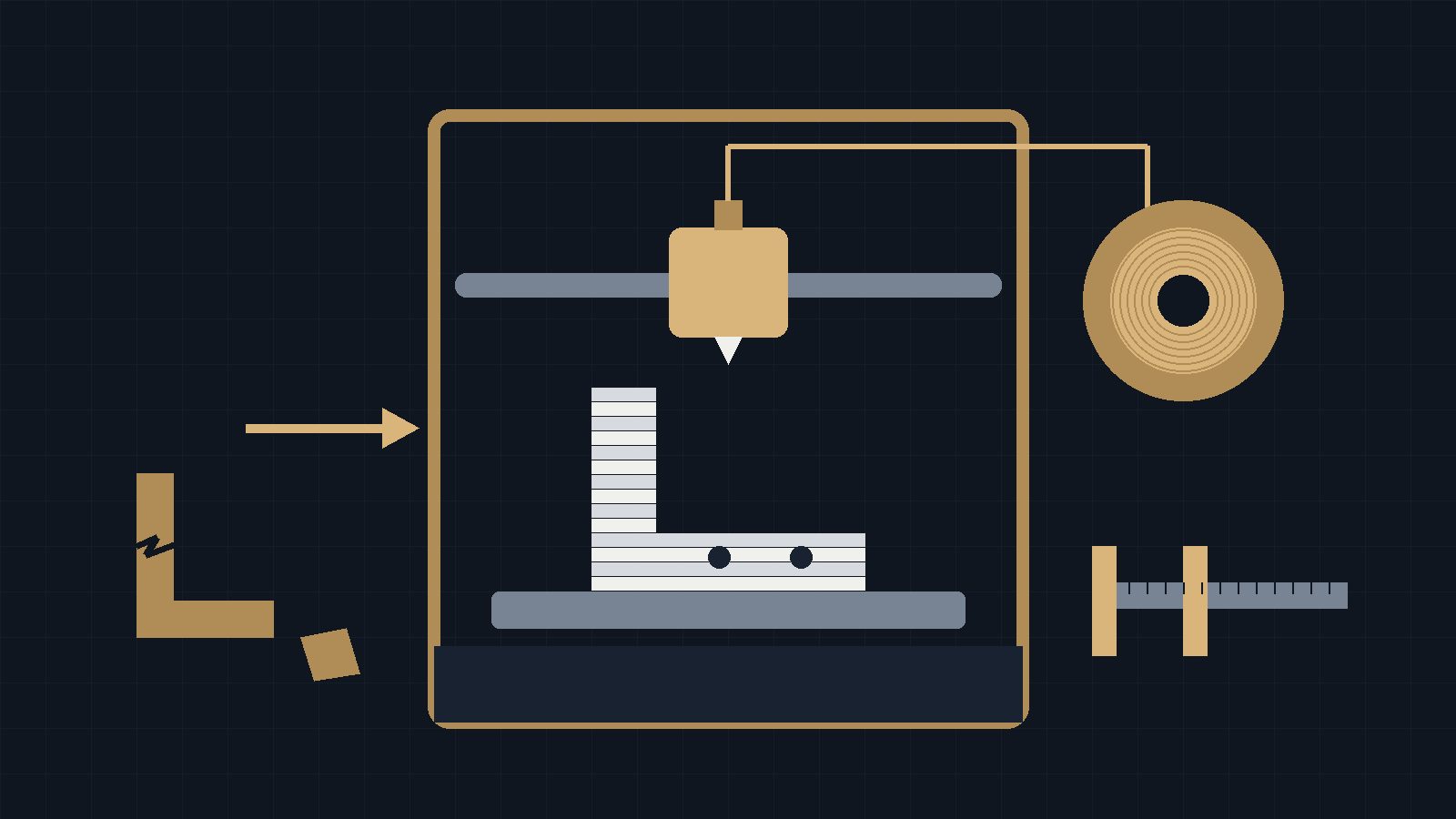
Often, yes. A 3D printer builds a part one thin layer at a time from a spool of plastic. If you have a model file, we print from that. If all you have is the broken original, we can measure it and draw it up, then print a new one. Pieces that are small, plastic and simple in shape are the easiest fits: knobs, clips, caps, covers, brackets and spacers.
What matters most is where the part lives and what it has to handle. A cover for a drawer and a bracket that sits outside all summer need very different plastics.
Which plastic for which replacement part
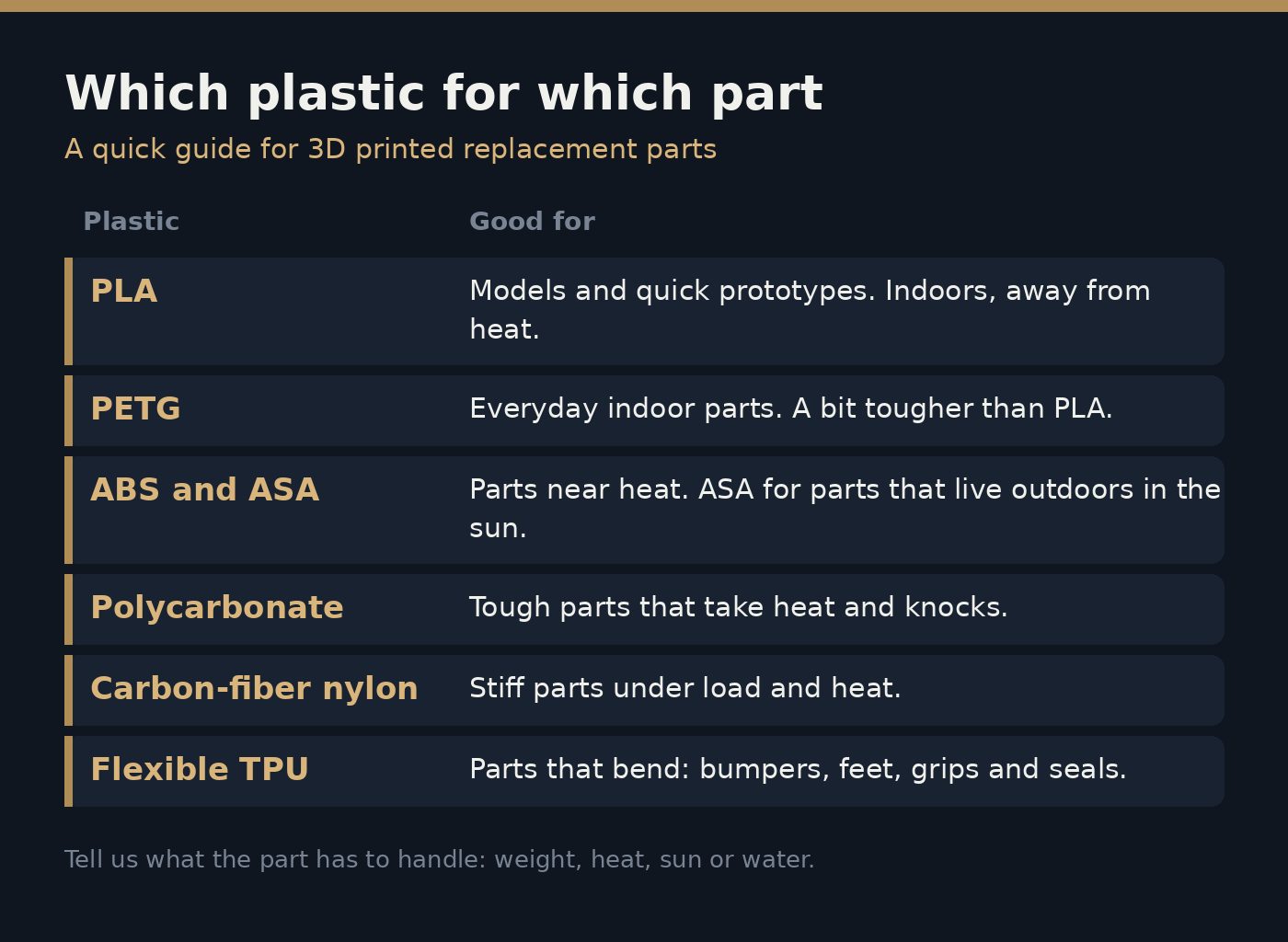
These are the plastics we print with, in plain words:
- PLA is easy to print and great for models and quick prototypes. It isn't a heat lover: Bambu Lab's filament guide says it isn't recommended for prints used around 50 °C or higher, where it may slowly soften. Inside a parked car in a Texas summer, that's a real concern.
- PETG is a good everyday choice for indoor parts. It's a bit tougher than PLA and takes a little more heat.
- ABS and ASA handle more heat. ASA is the one for outdoors: Prusa calls it suitable for outdoor use because of its high UV and temperature resistance.
- Polycarbonate is tough and takes both heat and knocks, so it suits parts that get bumped around.
- Carbon-fiber nylon is stiff and strong, for parts that carry a load or sit near heat, like brackets and mounts.
- Flexible TPU bends instead of breaking, for bumpers, feet, grips, seals and anything that needs a little give.
If you're not sure which one fits, that's fine. Tell us what the part does and where it lives, and we'll suggest a plastic.
Replacement parts worth asking about
A few kinds of pieces that tend to be good candidates for printing:
- Knobs and dials for appliances, furniture and equipment
- Clips, latches and catches for cabinets, cases and lids
- Battery covers and access panels
- Brackets and mounts for shelves, lights, cameras and tools
- End caps and plugs for tubing and furniture legs
- Feet, bumpers and pads (often in flexible TPU)
- Spacers, washers and shims
- Hooks, cable guides and organizers
- Fittings and covers for things that live outdoors (usually ASA)
- Small gears and parts for toys and hobby projects
Every part is different, so we look at each one before saying it's a good fit.
Why the direction it prints matters
Because a printed part is built in layers, it isn't equally strong in every direction. Polymaker, a filament maker, notes that printed parts are usually weakest along the Z axis, which is across the layers. So for a bracket or a clip, it pays to think about which way the load pulls and set the part on the printer so the layers carry it well. It's one reason a reprint of a broken part is worth a little planning instead of a straight copy.
What to send for a 3D printed part
- The model file if you have one (STL, STEP or 3MF), or the broken part itself
- A photo of the part, and a photo of where it goes
- A few measurements if you're sending photos only
- What the part has to handle: weight, heat, sun or water
- How many you need, even if it's just one
When printing isn't the right answer
A printed part isn't a match for everything. Something that carries serious weight over people, or a part that has to meet a safety rating, is better replaced with the maker's own part. And for thicker pieces in wood, plastic or soft aluminum, our CNC router can sometimes be a better tool than the printer.
If the broken thing is a phone, tablet, laptop or game console, that's a job for our repair side, Damage Control.
Tell us about the part
We work one piece at a time, and one is a fine quantity. Whether you're in Buda, Kyle, Austin or nearby, send us a photo of the broken part and a line about what it does. You can also call or text (512) 649-5492 or email hello@idamagecontrol.com.